
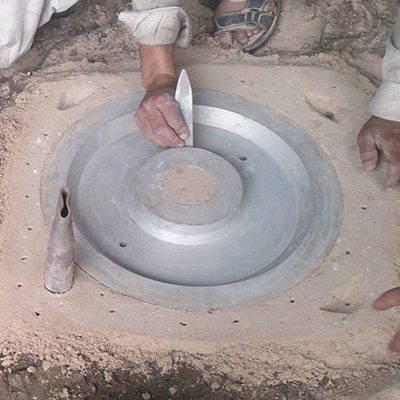
About Sand Casting
Sand casting is a widely used production technique for manufacturing industrial castings in various sizes and series. This casting method is applied both manually and automatically, depending on the desired quantities, complexity, and product specifications.
Sand casting is often used for materials such as cast iron, ductile iron, aluminum, steel, and stainless steel. As a result, this technique is suitable for a wide range of industrial applications where flexibility, customization, and cost-efficiency are important.
What is Sand Casting?
In sand casting, liquid metal is poured into a pre-made sand mold. After the material has cooled and hardened, the mold is removed, resulting in the desired part.
Depending on the product and the desired surface quality, molds are made of aluminum, composite, or in some cases, wood. Aluminum and composite generally provide a longer lifespan and a better finish, while wooden tools are primarily suitable for smaller series or one-off productions.
Advantages of Sand Casting
Sand casting offers several advantages for industrial production:
- great flexibility in product design and dimensions
- suitable for both small and large series
- cost-efficient for low quantities
- ability to produce large and heavy components
- applicable for complex shapes with internal structures
Production Process of Sand Casting
The sand casting production process is relatively simple, but it requires technical knowledge and precise preparation. If necessary, cores are used to create complex internal shapes or recesses.
In addition, draft angles, material shrinkage, and the construction of tooling parts are taken into account. This results in a reliable production process with consistent dimensions and reproducible quality.
Applications of Industrial Castings
Sand casting is suitable for a wide range of industrial castings, from smaller components starting at approximately 200 grams to large parts weighing thousands of kilograms.
This production technique is widely used in mechanical engineering, transport, trailer construction, and other industrial sectors where strong, durable, and dimensionally stable castings are required.


